Can Two Countries Legally Claim Jurisdiction Over the Same Online Activity?
The internet allows people, businesses, platforms, and governments to interact across national borders in seconds. A person can live in one country, use a website operated from another country, communicate with someone in a third country, and store related data on servers located in several other countries.
This creates an important legal question: Can two countries legally claim jurisdiction over the same online activity?
Yes. Two or more countries can sometimes have jurisdiction over the same online activity. This situation is often called concurrent jurisdiction. It can happen when an online activity has meaningful connections to more than one country, such as where the person is located, where a victim is located, where a company operates, where a computer system is located, or where the effects of an activity occur.
Jurisdiction does not automatically mean that every country can enforce its laws anywhere in the world. International law, domestic law, treaties, sovereignty, and practical enforcement limits all matter.
For example, a person in Country A might use a computer to commit an online offense against a victim in Country B while using a service operated by a company in Country C. Country A may have jurisdiction because the person acted there. Country B may have jurisdiction because the victim or harmful effects were there. Country C may have a separate legal connection because its infrastructure, company, or data is involved.
The result can be legally complicated because several countries may have legitimate interests in the same conduct.
What Does Jurisdiction Mean in Online Activity?
Jurisdiction is the legal authority of a government or court to apply its laws, investigate conduct, bring a case, or make certain legal decisions.
In ordinary situations, jurisdiction is often easier to understand because physical borders are visible. If a person commits an offense inside a country, that country’s legal system will normally have a strong territorial connection to the conduct.

Online activity is different.
Digital activity can cross borders almost instantly. A single online action may involve:
- A user in one country
- A victim in another country
- A website or platform based in a third country
- Servers located somewhere else
- Payment systems in another jurisdiction
- Domain registration in another country
- Digital evidence stored in multiple locations
Because of these connections, more than one country may have a legal basis for claiming jurisdiction.
The International Court of Justice has recognized territorial jurisdiction as an important principle of international law while also explaining that international law does not always prevent states from exercising jurisdiction over conduct connected to events outside their territory.
Therefore, the key question is usually not simply where the internet user clicked a button. Authorities may examine the complete set of connections between the online activity and different countries.
Why Can Two Countries Have Jurisdiction Over One Online Activity?
Two countries may have jurisdiction because the same activity creates legally relevant connections in both places.
For example, imagine that a person located in Country A conducts an online fraud operation targeting customers in Country B.
Country A may argue that the conduct occurred within its territory because the person used a computer there.
Country B may argue that the offense affected people, businesses, financial accounts, or computer systems within Country B.
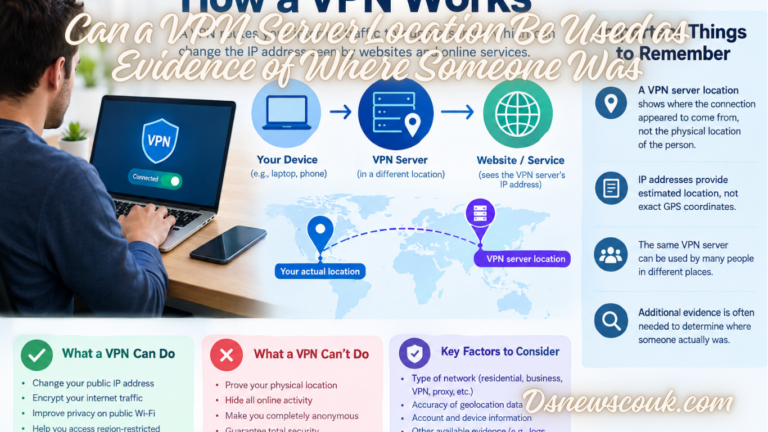
Also Read: Can a VPN Server Location Be Used as Evidence of Where Someone Was?
Both countries can therefore have a legitimate legal interest.
Also Read: Does DSNews.co.uk Cover Technology Topics? A Complete Guide
This does not necessarily mean both countries will prosecute the person. Jurisdiction and actual enforcement are separate questions.
A country may have legal authority to investigate or prosecute but still decide that another country is better positioned to handle the case. Countries can also cooperate through extradition agreements, mutual legal assistance, joint investigations, or other international mechanisms.
The U.S. Department of Justice explains that international legal assistance becomes more difficult because investigations can involve multiple legal systems and different rules for obtaining evidence.
Territorial Jurisdiction and the Location of the Conduct
Territorial jurisdiction is one of the most important concepts in international law.
Under this approach, a country generally has authority over conduct occurring within its territory.
Online activity makes the location of conduct more complicated.
Consider an individual physically located in the United States who sends a fraudulent message to someone in France. The person who sends the message is in the United States, while the recipient is in France.
The United States may have a territorial connection because the conduct originated there.
France may have a territorial or effects-based connection because the recipient and consequences are located there.
The exact legal result depends on the applicable laws and facts.
The Budapest Convention on Cybercrime illustrates how territoriality remains an important basis for cybercrime jurisdiction. Article 22 requires participating countries to establish jurisdiction over covered offenses committed in their territory, while also addressing nationality and other connections.
Territorial jurisdiction therefore remains important even when the activity itself is digital.
The Effects Principle in Cross-Border Internet Cases
Another important concept is the effects principle.
Under this approach, a country may assert jurisdiction when conduct outside its territory produces legally significant effects inside the country, depending on the relevant law.
This can be especially important in online cases because digital conduct can cause consequences far from where the person was physically located.
For example, an overseas actor could target U.S. financial institutions, consumers, computer networks, or businesses.
In some U.S. federal cases, the connection between foreign conduct and effects inside the United States can be relevant when determining whether U.S. law applies. Department of Justice materials discussing cybercrime have recognized circumstances in which intended or actual detrimental effects in the United States can support extraterritorial application of U.S. law.
However, the effects principle is not a universal permission to regulate everything that happens online. The specific statute, treaty, facts, and international-law limits must be considered.
Nationality Can Also Create Jurisdiction
A country may sometimes assert jurisdiction because of the nationality of the person involved.
For example, a country may have laws that apply to its citizens or nationals even when they engage in certain conduct outside the country’s territory.
The Budapest Convention provides an example of this approach. Article 22 includes jurisdiction over certain covered offenses committed by nationals, subject to the conditions described in the treaty.
This means that physical location is not always the only factor.
An online activity can potentially have several connections at once:
- The nationality of the person
- The person’s physical location
- The location of the victim
- The location of a business
- The location of affected systems
- The location of relevant property
- The location of evidence
These overlapping connections help explain why two countries can sometimes legally claim jurisdiction over the same activity.
How Online Crimes Can Cross National Borders
Cybercrime is one of the clearest examples of overlapping jurisdiction.
A single cyber incident may involve a large number of countries.
For example, a hypothetical attack might involve:
- An attacker located in Country A.
- A compromised server located in Country B.
- A victim’s computer located in Country C.
- A cloud provider headquartered in Country D.
- Financial losses occurring in Country E.
Each country may have a different legal interest.
Country A may focus on the person who carried out the conduct.
Country B may focus on unauthorized activity involving infrastructure within its territory.
Country C may focus on the affected victim or computer system.
Country D may become relevant because of data controlled by a service provider.
Country E may focus on financial harm occurring within its borders.
The U.S. Department of Justice notes that electronic evidence can be held by companies operating across borders and that customer locations, corporate offices, and data storage facilities may exist in different countries.
This makes cybercrime investigations particularly dependent on international cooperation.
Can a Website Be Subject to the Laws of More Than One Country?
Yes, a website or online service can potentially be affected by the laws of multiple countries.
A website may have:
- Owners in one country
- Employees in another country
- Servers in several countries
- Users around the world
- Advertisers in different jurisdictions
- Payment providers in other countries
- Data centers in different regions
The existence of a website alone does not automatically give every country unlimited jurisdiction over it.
Instead, authorities generally examine the specific connection between the service and their jurisdiction.
For example, a country may have laws governing businesses that operate within its territory. Another country may have consumer protection rules that apply to transactions with people located there. A third country may have privacy or data protection requirements connected to information processed within its jurisdiction.
Therefore, an international website may need to consider multiple legal systems.
Why the Location of Data Does Not Always Decide Jurisdiction
Many people assume that the country where a server is located automatically controls the entire legal issue.
That is not always correct.
Modern cloud systems can distribute data across multiple facilities and countries. A company may also control data even when the physical storage location is outside the country where the company is based.
The U.S. CLOUD Act is one example of how U.S. law addresses electronic information controlled by certain providers. The Department of Justice explains that the law allows qualifying legal demands to reach electronic information held by U.S.-based global providers regardless of where the data is stored, subject to applicable legal requirements.
This creates an important distinction:
Data location and legal control are not always the same thing.
At the same time, another country may have laws that restrict the transfer or disclosure of information located or protected within its jurisdiction.
That is one reason international data requests can create legal conflicts.
What Happens When Two Countries Want the Same Digital Evidence?
Overlapping jurisdiction can become particularly difficult when authorities in different countries want access to the same digital evidence.
Evidence may include:
- Emails
- Login records
- IP information
- Subscriber information
- Payment records
- Cloud files
- Device records
- Server logs
- Communication metadata
- Account information
The Council of Europe explains that electronic evidence can exist in many places, including devices, networks, local servers, and servers located anywhere in the world.
A government may therefore need evidence that is physically or legally controlled outside its territory.
Countries often use international legal assistance procedures to obtain that evidence.
The United States Department of Justice describes Mutual Legal Assistance Treaties, or MLATs, as important mechanisms through which law enforcement agencies can request assistance from foreign counterparts.
These procedures help protect national sovereignty while allowing investigations to cross borders legally.
Mutual Legal Assistance and Cross-Border Investigations
Mutual Legal Assistance is a formal process through which one country asks another country for help with an investigation or prosecution.
For example, U.S. investigators may need records held by a company or authority in another country.
Instead of simply sending U.S. officials into that country to collect the evidence themselves, the request may be handled through the country’s legal system.
The foreign country reviews the request according to applicable treaties and domestic law.
The process can involve:
- A formal evidence request
- Review by a central authority
- Judicial authorization
- Data collection
- Privacy protections
- Transfer of evidence
- Authentication or other evidentiary requirements
The U.S. Department of Justice’s Office of International Affairs handles international evidence gathering and related cooperation, including mutual legal assistance and extradition matters.
These systems exist because one country’s law enforcement agency generally cannot simply exercise unlimited governmental power inside another sovereign country.
The Budapest Convention and Cybercrime Jurisdiction
The Budapest Convention on Cybercrime is an important international framework for understanding cross-border cybercrime cooperation.
The Council of Europe describes it as a major international agreement concerning cybercrime and electronic evidence and as a framework for cooperation between participating states.

Its jurisdiction provisions address offenses committed:
- Within a country’s territory
- On ships flying its flag
- On aircraft registered under its laws
- In certain circumstances by its nationals
The Convention also states that its jurisdiction provisions do not exclude criminal jurisdiction available under a country’s domestic law.

This is significant because it shows that international cybercrime law does not necessarily create a single worldwide jurisdiction.
Instead, it provides rules and cooperation mechanisms while leaving substantial questions to domestic law.
What If the Laws of Two Countries Conflict?
A difficult situation can arise when Country A requires a company to provide information while Country B’s law restricts that disclosure.
This is not merely theoretical.
The U.S. Department of Justice has specifically described situations in which companies with international operations may face conflicting legal obligations because different countries’ laws apply to the same electronic data.
For example, one country might issue a lawful order requiring disclosure of customer information.
Another country might impose privacy or data-transfer restrictions on the same information.
The company may then face competing legal requirements.
International agreements can reduce some of these conflicts.
The U.S. CLOUD Act and certain bilateral agreements are designed, among other things, to create clearer procedures for obtaining electronic evidence across borders.
However, these frameworks do not eliminate every conflict.
Does Having Jurisdiction Mean a Country Can Arrest Someone Anywhere?
No.
This is an important distinction.
A country can have jurisdiction over an alleged offense without automatically having the physical authority to arrest a person inside another country.
Territorial sovereignty places practical and legal limits on law enforcement activity.
For example, if U.S. authorities believe that a suspect located overseas committed an offense under U.S. law, they generally cannot simply enter the foreign country and make an arrest as though the foreign territory were U.S. territory.
International procedures may instead involve:
- Extradition
- Deportation or removal under applicable law
- Mutual legal assistance
- Cooperation between law enforcement agencies
- International warrants or notices
- Domestic proceedings in the country where the person is located
The Department of Justice’s Office of International Affairs works on international extradition and evidence gathering as part of this broader system.
Thus, jurisdiction and enforcement power are related but different concepts.
Which Country Prosecutes When Both Have Jurisdiction?
There is no single worldwide rule that automatically determines which country must prosecute first.
Authorities may consider many factors, such as:
- Where most of the conduct occurred
- Where the victims are located
- Where the greatest harm occurred
- Where evidence is available
- Where the suspect is located
- Which country has stronger legal authority
- Whether the offense violates both countries’ laws
- Whether extradition is possible
- Whether another country has already started proceedings
- Whether international agreements affect the case
Sometimes countries cooperate rather than compete.
One country may investigate while another prosecutes.
In other situations, authorities may coordinate decisions about evidence, suspects, and proceedings.
The U.S. Department of Justice explains that international legal assistance can produce results different from what a domestic prosecutor might expect because multiple legal codes and procedures are involved.
Therefore, overlapping jurisdiction does not necessarily mean that two trials will occur.
How Jurisdiction Applies to Social Media and Online Speech
Social media creates additional jurisdiction questions.
A post may be created in one country, hosted by a platform based in another country, and viewed by people across the world.
Different countries may regulate the same online speech differently.
Potential legal issues can include:
- Defamation
- Privacy
- Consumer protection
- Intellectual property
- Election-related rules
- Hate speech laws
- Data protection
- National security laws
- Criminal offenses
The existence of an international audience does not automatically mean every country has unlimited authority over every post.
Courts and governments may examine factors such as the target audience, location of the parties, effects within the country, applicable statutes, and the nature of the dispute.
For individuals and businesses, this means that publishing something online can sometimes create legal exposure beyond the country where the person is physically located.
How Businesses Should Understand Cross-Border Online Jurisdiction
Businesses operating online often have more jurisdictional connections than individual users.
A company may sell products to customers in many countries while using international cloud providers and payment processors.
Important legal areas can include:
- Consumer protection
- Privacy
- Data protection
- Tax
- Advertising
- Intellectual property
- Cybersecurity
- Financial regulation
- Employment law
- Contract law
A business should not assume that its headquarters determine every legal obligation.
Instead, it may need to identify where it operates, who it serves, what data it processes, and what activities it conducts in each jurisdiction.
International compliance is therefore often based on a combination of domestic law, contractual arrangements, treaties, and professional legal advice.
How Individuals Can Reduce Cross-Border Legal Risk
Ordinary internet users can also encounter international legal issues.
Also Read: Does DSNews.co.uk Cover Technology Topics? A Complete Guide
A person does not necessarily need to be physically present in another country for online conduct to have consequences there.
Also Read: Does a UK Website Automatically Use UK Law for Every Visitor?
Basic digital safety practices include:
- Understand the laws that apply to your online activities.
- Be careful when conducting business across borders.
- Avoid unauthorized access to computer systems.
- Do not assume that foreign websites are outside all legal systems.
- Check privacy and data-transfer terms when sharing sensitive information.
- Keep records of important online transactions.
- Understand the location of the other party in international disputes.
- Seek qualified legal advice for serious cross-border matters.
A VPN, proxy, cloud service, or foreign server does not automatically remove legal jurisdiction.
Changing the technical route of an internet connection and changing the legal location of conduct are two different things.
Common Misunderstandings About Online Jurisdiction
Several myths can make international internet law seem simpler than it really is.
One common misunderstanding is that the country where a server is located automatically has exclusive jurisdiction. Server location can matter, but it is only one possible connection.
Another misconception is that using a VPN automatically places activity under the VPN server’s country’s laws. A VPN can change the apparent network location of a connection, but it does not automatically determine which country’s law applies.
Some people also believe that an international website is outside national law because it has no physical storefront. In reality, online businesses can have significant legal connections with multiple countries.
Another misconception is that having jurisdiction means a country can enforce its law anywhere. Jurisdiction and enforcement authority are separate concepts.
Finally, some people assume that only one country can legally claim jurisdiction. In reality, overlapping jurisdiction can occur when several countries have meaningful connections to the same activity.
Conclusion
Two countries can legally claim jurisdiction over the same online activity. This can happen because the activity crosses borders and creates meaningful legal connections in more than one country.
One country may have jurisdiction because the person acted there. Another may have jurisdiction because the victim, business, computer system, or harmful effects were there. A third country may become involved because important evidence or a service provider is located there.
However, having jurisdiction does not automatically give a country unlimited enforcement power outside its borders. Arrests, searches, evidence collection, extradition, and other government actions may require cooperation with the country where the relevant person, property, or data is located.
For U.S. internet users and businesses, the main lesson is that online activity can have cross-border legal consequences. The physical location of a person, the location of a server, the nationality of the parties, and the location of the effects can all matter.
As digital services become more international, understanding concurrent jurisdiction, territorial jurisdiction, extraterritorial law, electronic evidence, and international legal assistance is increasingly important. When a specific dispute involves possible criminal liability, significant financial exposure, or conflicting laws between countries, professional legal advice based on the actual facts is appropriate.
FAQs About Can Two Countries Legally Claim Jurisdiction Over the Same Online Activity
1. Can two countries investigate the same online activity at the same time?
Yes, multiple countries may investigate when the activity has legal connections to each jurisdiction.
Authorities may cooperate by sharing evidence or coordinating their investigations.
2. Does the country where an online activity starts always have jurisdiction?
No, the starting location is only one possible factor in determining jurisdiction.
The victim’s location, effects, nationality, and affected systems may also be relevant.
3. Can an online business face legal requirements in several countries?
Yes, an international business may need to follow laws in multiple jurisdictions.
Its obligations can depend on its customers, operations, data, and other local connections.
4. Can digital evidence be requested from another country?
Yes, authorities can use international legal assistance procedures to request evidence abroad.
The process normally depends on treaties, domestic laws, and the cooperation of the other country.
5. Can a country claim jurisdiction without being able to enforce its laws abroad?
Yes, legal jurisdiction and physical enforcement authority are different concepts.
A country may have jurisdiction while needing international cooperation to arrest a person or obtain evidence overseas.