Can a VPN Server Location Be Used as Evidence of Where Someone Was?
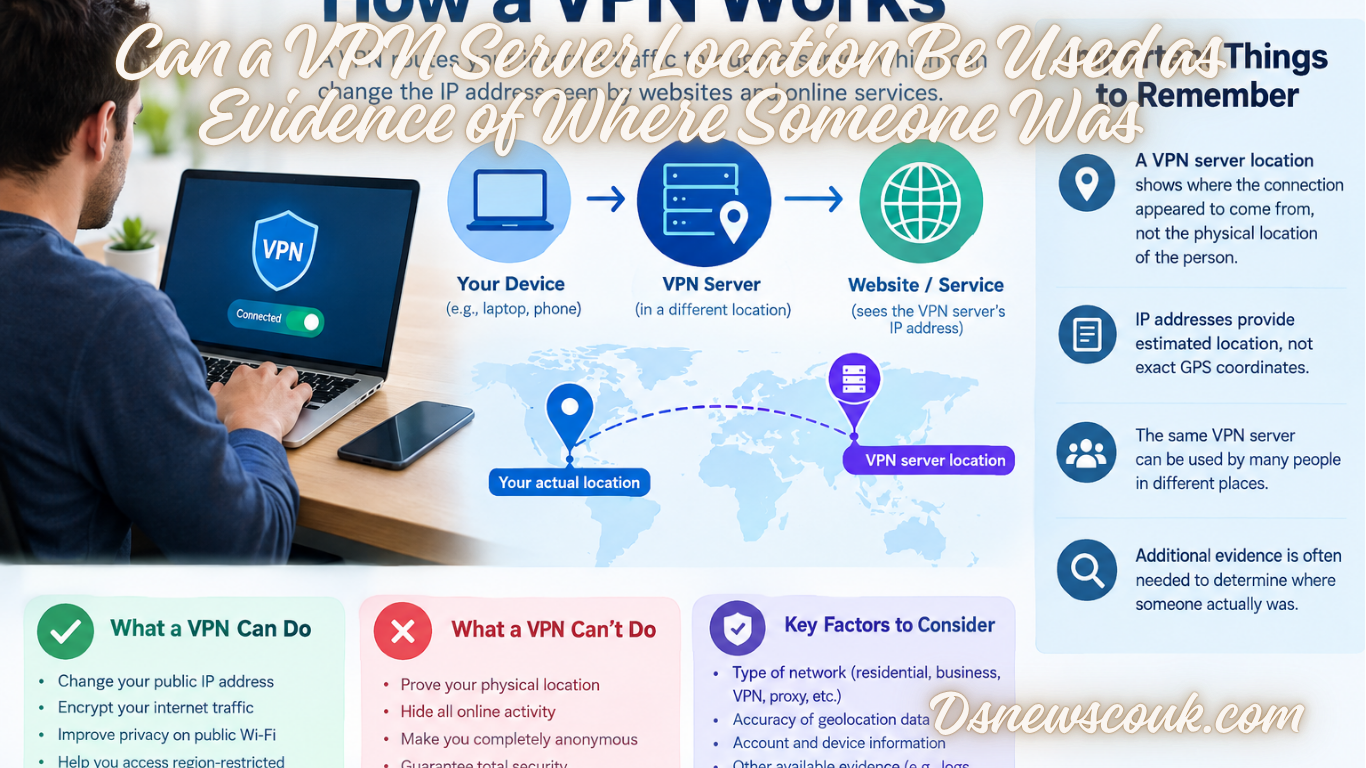
A Virtual Private Network, commonly called a VPN, can change the IP address that websites and online services see when someone connects to the internet. This can create confusion when an IP address is later examined as part of a security investigation, workplace dispute, civil case, or other legal matter.
A common question is: Can a VPN server location be used as evidence of where someone was?
The short answer is that a VPN server location can provide information about the network connection being observed, but it usually does not prove the physical location of the person who used the connection.
For example, someone could physically be in Texas while connected to a VPN server in New York. A website might record a New York IP address. An IP geolocation service could then associate that address with New York. However, this does not automatically mean the person was physically in New York.
This distinction is important because an IP address is not the same thing as GPS data. IP geolocation generally provides an estimated location associated with a network address. It does not directly track the physical position of a person.
The question Can a VPN server location be used as evidence of where someone was? therefore requires a more detailed answer. A VPN server location can be evidence of where an internet connection appeared to originate, but additional evidence is normally needed to establish where a person or device was physically located.
What Is a VPN Server Location?
A VPN server location is the geographic location associated with a server through which a VPN provider routes internet traffic.

When a person connects to a VPN, their device establishes an encrypted connection with the VPN service. Internet traffic can then pass through the VPN server before reaching the destination website or online service.
A simplified connection looks like this:
User’s device → VPN server → Website or online service
Without a VPN, a website may see the public IP address associated with the user’s ordinary internet connection.
With a VPN, the website will commonly see the VPN server’s public IP address instead.
Suppose a person lives in Florida but selects a VPN server in California. The website may see an IP address associated with California. An IP lookup may also display California as the approximate location.
The person, however, has not physically traveled to California.
This is why the term “VPN server location” should be understood as a network-related location rather than automatically as a person’s physical location.
A VPN server can be located in a data center, cloud facility, or other network infrastructure. The location associated with its IP address may also be based on registration or geolocation databases rather than a precise physical measurement.
How Does a VPN Change the Location Shown by an IP Address?
Also Read: Does Using a VPN Change Which Country’s Law Applies? A Complete Guide
IP addresses can also provide approximate geographic information because internet service providers, hosting companies, and network operators are associated with particular regions.
Also Read: Does DSNews.co.uk Cover Technology Topics? A Complete Guide
An IP address identifies a connection point on a network. Websites use IP addresses to communicate with devices and services across the internet.
A VPN changes the situation by placing another server between the user’s device and the destination website.
For example:
A user in Arizona connects to a VPN server in Illinois.
The user’s traffic travels through the VPN.
The website sees the VPN server’s public IP address.
The website may therefore associate the activity with Illinois.
The website may not see the user’s ordinary Arizona public IP address.
This does not mean that the VPN has physically moved the user’s device.
It only means that the internet traffic is being presented to the destination through another network endpoint.
This distinction becomes especially important when someone tries to use an IP lookup as evidence of physical presence.
Can a VPN Server Location Be Used as Evidence of Where Someone Was?
Can a VPN server location be used as evidence of where someone was? It can be considered evidence of the network location through which online activity appeared to originate, but it normally should not be treated by itself as conclusive evidence of the user’s physical location.
This difference can be explained through a simple example.
Imagine an online service records this information:
IP address: 203.0.113.10
An IP intelligence service identifies the address as belonging to a commercial VPN provider and associates it with a server in Chicago.
That record may support several observations:
- The online service received traffic from that IP address.
- The IP address was associated with a VPN service.
- The address was geographically associated with Chicago.
- The connection appeared to originate from that VPN infrastructure.
But the same record does not automatically establish:
- The person was physically in Chicago.
- The person’s phone was in Chicago.
- The person’s computer was in Chicago.
- The account owner personally made the connection.
- Nobody else had access to the account.
Therefore, the evidentiary meaning of a VPN location depends heavily on what question investigators are trying to answer.
If the question is where the online connection appeared to originate, the VPN IP can be useful.
If the question is where a specific person physically was, more evidence may be necessary.
Why a VPN IP Address Does Not Automatically Show Physical Location
One of the most common misunderstandings about IP evidence is treating an IP address as though it were a GPS coordinate.
An IP address does not work that way.
IP geolocation systems estimate geographic information using databases and network-related information. The accuracy can vary depending on the type of connection, internet service provider, network configuration, mobile network, hosting provider, and other factors.
This becomes even more complicated when the address belongs to a VPN.
A commercial VPN can have servers in many different cities and countries. Users can select a server based on the available locations offered by the provider.
The person could therefore be hundreds or thousands of miles away from the geographic location associated with the VPN IP.
There is another important issue: the location shown by an IP lookup may not represent the exact physical location of the server itself.
An IP address can be registered to an organization at one location while the actual network equipment is located somewhere else. Different geolocation databases can also produce different city or regional results.
For these reasons, an IP address is better understood as network evidence than as direct physical-location evidence.
What Information Can a VPN IP Address Reveal?
A VPN IP address can still provide useful information.
Depending on the available databases and records, researchers or investigators may be able to determine that an IP address belongs to a VPN provider, hosting company, proxy service, or another type of network.
An IP intelligence service may also provide an estimated country, region, or city.
Other information can sometimes include:
- Internet service provider or network operator
- Autonomous system information
- Organization associated with the address
- Connection type
- Whether the address appears to be a VPN or proxy
- Approximate geographic region
- Whether the address belongs to a hosting provider
This information can help explain the technical path of an online connection.
However, each piece of information needs to be interpreted correctly.
For example, if a database says an IP is associated with New York, that does not necessarily mean the person was in New York. It may mean that the IP address has been associated with a VPN server or network in that region.
The difference may seem small, but it can have major consequences when digital evidence is being interpreted.
Can Investigators Identify That a VPN Was Used?
In many cases, investigators and security systems can identify whether an IP address appears to belong to a VPN or other anonymizing service.
Commercial IP intelligence databases maintain information about known VPNs, proxies, hosting networks, and other types of infrastructure.
A website may also recognize unusual connection patterns.
For example, a large number of unrelated users may appear to connect from the same IP address. That can be a sign that the address belongs to a shared service such as a VPN, proxy, corporate network, university, or public network.
VPN detection does not necessarily identify the person behind the connection.
Instead, it can provide an important clue about the type of connection involved.
Once investigators know that a VPN was used, they may need to consider additional questions.
Who operated the VPN?
Was the IP shared by many customers?
What records exist for the relevant time?
How accurate is the IP geolocation information?
Was the account protected by additional authentication?
What other devices or accounts were active at the same time?
These questions can be more useful than simply asking which city appears in an IP lookup.
Can a VPN IP Identify the Person Who Used an Account?
A VPN IP address generally cannot, by itself, identify the individual person who used an account.
Even a normal residential IP address has limitations.
For example, one home internet connection can be shared by parents, children, visitors, smart devices, and other users. A business network can have hundreds of employees sharing a public IP address.
A VPN adds another layer of sharing.
A single VPN server may serve many customers. Those customers can connect from completely different physical locations while appearing to online services under the same public IP address.
This means an IP address usually identifies a network connection or endpoint rather than a specific human being.
Account information can provide additional context, but account ownership also does not automatically establish who was physically operating the account at a particular moment.
For example, an account could be shared, compromised, accessed by a family member, or used from a device that belongs to someone else.
This is why digital investigations generally need to distinguish between an IP address, an account, a device, and a person.
They are related, but they are not automatically the same thing.
How VPN Logs Can Affect Location Evidence
VPN logs can sometimes provide additional information, although the amount and type of information available varies between providers and systems.
Depending on the provider and its technical practices, records may potentially include information about account activity, connection times, server use, or other technical events.
The existence of such records depends on the provider’s infrastructure, retention practices, policies, and applicable legal requirements.
This means investigators cannot safely assume that every VPN provider has the same type of information.
The same is true of claims about “no logs.” A general marketing statement does not automatically explain every technical record a provider may create or retain.
If records are available and can legally be obtained, they may provide additional context about how a connection was established.
However, VPN provider records still need to be interpreted carefully.
A connection record might show that an account or device connected to a VPN server at a certain time. It does not necessarily establish the physical location of the individual using that account.
Other evidence may still be required to connect the technical record to a particular person or location.
Can a VPN Server Location Be Used in a Court Case?
Can a VPN server location be used as evidence of where someone was in a court case? It can potentially be introduced as part of digital evidence, but its meaning and evidentiary weight depend on the facts and applicable law.
Courts can consider digital records in many types of proceedings. However, evidence generally needs to satisfy applicable legal requirements concerning issues such as relevance, authenticity, reliability, and admissibility.
A VPN IP record might be relevant to an investigation because it shows that an online service recorded a connection from a particular IP address.
The important question is what conclusion that record supports.
For example, a record may support:
“An account accessed this service through an IP address associated with a VPN server in Colorado.”
That is a technical statement.
It is different from:
“The person who owned the account was physically in Colorado.”
The second statement requires a stronger factual connection.
A court may consider the reliability of the underlying records, how the IP address was identified, how geolocation was performed, and whether other evidence supports the proposed conclusion.
Because legal standards differ by jurisdiction and case type, anyone dealing with an actual legal dispute should consult a qualified attorney familiar with the applicable rules.

What Other Evidence Can Establish Someone’s Location?
When physical location is important, investigators may examine several different types of evidence.
Potential evidence can include:
- Device location records
- Mobile network records
- Wi-Fi connection information
- Account access records
- Server logs
- Transaction records
- Digital forensic evidence
- Communications records
- Surveillance footage
- Witness statements
- Building access records
- Vehicle-related records
- Other independently obtained records
The exact evidence available depends on the circumstances.
For example, a smartphone may contain location information that is technically different from an IP address. A device may also connect to a particular Wi-Fi network at a particular time.
Similarly, security camera footage could potentially provide physical evidence that a person was at a specific place.
These sources can sometimes be compared with online activity.
Suppose an account was accessed through a VPN server in Nevada at 8:00 p.m. The VPN record alone does not establish that the person was in Nevada.
If separate, properly obtained evidence shows that the relevant device was physically somewhere else at that same time, the VPN location may be interpreted differently.
This illustrates why digital evidence is often strongest when different sources are evaluated together rather than in isolation.
VPN Server Location vs. GPS Location
VPN location and GPS location are fundamentally different types of information.
GPS is designed to determine the geographic position of a device using satellite signals and related positioning systems.
A VPN, by contrast, is designed primarily to route internet traffic through another network endpoint.
Consider the following example:
A phone is physically located in Miami.
The phone connects to a VPN server in Seattle.
The VPN can make the internet traffic appear to come from Seattle.
The device’s GPS, if enabled and available, may still indicate Miami.
This demonstrates why the two forms of location information should not be confused.
GPS can have its own limitations. Indoor environments, signal conditions, device settings, and other technical factors can affect positioning accuracy.
However, the type of information is different from IP geolocation.
IP geolocation answers a network-related question such as:
“Where is this IP address generally associated?”
GPS answers a device-positioning question such as:
“Where does the device appear to be located?”
Neither should automatically be treated as perfect, but they measure different things.
What Are the Main Limitations of VPN Location Evidence?
There are several limitations that should be considered when interpreting VPN server location evidence.
The first limitation is the distance between the user and the VPN server.
A person can be far away from the server.
The second limitation is shared infrastructure.
Multiple people can use the same VPN server and public IP address.
The third limitation is IP geolocation accuracy.
The city or region associated with an IP may be estimated rather than exact.
The fourth limitation is account attribution.
An account may be shared, compromised, or accessed by someone other than its owner.
The fifth limitation is changing network infrastructure.
VPN providers can add servers, move infrastructure, change IP addresses, or modify their network arrangements.
The sixth limitation is database accuracy.
Different IP intelligence services may have different information about the same address.
The seventh limitation is the difference between an IP registration location and the physical location of network equipment.
These limitations do not make VPN evidence useless.
Instead, they define what conclusions can reasonably be drawn from it.
A technically accurate IP record can still be misunderstood if someone assumes that the IP location automatically represents a person’s physical location.
Can a VPN Server Location Be Wrong?
Can a VPN server location be wrong? Yes, especially if the displayed location is interpreted as the exact physical location of the user.
There are several reasons an IP location may appear different from a person’s actual location.
A geolocation provider may estimate a city based on network information.
The IP address may be registered to an organization in one location while the infrastructure is elsewhere.
A VPN provider may use data centers or hosting arrangements that do not perfectly match the city shown by an IP database.
Different databases may also provide different results.
For example, one service might identify an IP as being in Chicago while another identifies the same address as being in a nearby region.
This does not necessarily mean that one system is intentionally misleading users. IP geolocation involves estimation and changing network data.
The level of accuracy also varies between countries and types of networks.
Therefore, anyone analyzing an IP address should ideally understand the source of the geolocation data, its methodology, and its limitations.
How Should a VPN Location Be Interpreted in a Digital Investigation?
A useful way to analyze VPN evidence is to separate technical facts from conclusions.
Start with the technical fact.
What IP address was recorded?
Next, determine what the IP represents.
Does it belong to a residential internet provider, business network, hosting company, proxy, or VPN?
Then determine the geographic information associated with that IP.
Which database produced the location?
What level of accuracy does the database claim?
Finally, ask what independent evidence connects the online activity to a specific person or physical location.
This method reduces the risk of turning a limited technical observation into a much broader conclusion.
For example:
Technical fact: An account accessed a website through a VPN IP.
Network fact: The IP was associated with a VPN provider.
Geographic fact: The IP was estimated to be associated with Boston.
Attribution question: Who was using the account?
Physical-location question: Where was that person actually located?
These are separate questions.
Treating them separately produces a more accurate understanding of digital evidence.
Also Read: Does a UK Website Automatically Use UK Law for Every Visitor?
How VPN Use Affects Privacy and Digital Safety
Also Read: Is DSNews.co.uk a News-Only Website? Complete Guide to Its Content
VPNs are commonly used for privacy, security, remote work, public Wi-Fi protection, and other legitimate purposes.
A VPN can prevent many websites from seeing the user’s normal public IP address. It can also encrypt traffic between the user’s device and the VPN server.
However, a VPN does not automatically provide complete anonymity.
Websites can still obtain information through other mechanisms.
For example, a user may log into a personal account while using a VPN. The account itself can identify the user to the service.
Websites can also use cookies, browser information, device characteristics, authentication data, and other technologies.
A VPN therefore changes one important part of the connection but does not erase every other source of information.
Users should also remember that trust is shifted toward the VPN provider. The provider operates the server through which the traffic passes, so choosing a VPN service involves considering its privacy practices, security design, transparency, and business model.
The exact protections offered by different VPN services can vary.
Understanding those limitations is part of good digital literacy.
Frequently Asked Questions About VPN Server Location Evidence
Can a VPN location be used to prove that someone traveled to another state?
Not by itself. A VPN can make internet traffic appear to originate from a server in another state without the user physically traveling there. Evidence of actual travel would generally require other information that independently connects the person or device to that physical location.
Does a VPN server have the same IP address for every user?
Not necessarily. VPN providers can operate many servers and IP addresses. Multiple users may share one public IP address, while other users may receive different addresses depending on the provider’s network and connection system.
Can two IP geolocation services show different locations?
Yes. IP geolocation is based on databases and estimation methods, so different services can sometimes produce different city or regional results for the same IP address. The difference is one reason IP location should be interpreted with appropriate caution.
Does using a VPN change the location stored by an online account?
It can change the IP-based location information recorded by a service. However, an account may also have other location-related information from devices, applications, previous connections, account settings, or other sources. A VPN does not necessarily change every type of location information associated with an account.
Can someone prove their physical location was different from a VPN server?
Potentially, depending on what records are available. Evidence such as device records, location data, network information, transaction records, surveillance footage, or other independently verified information may help establish physical location. The usefulness of any particular evidence depends on its accuracy, authenticity, timing, and legal context.
Conclusion
Can a VPN server location be used as evidence of where someone was? Yes, a VPN server location can be relevant evidence about an online connection, but it normally does not prove a person’s physical location by itself.
A VPN works by routing internet traffic through a server. As a result, websites and online services may record the VPN server’s public IP address instead of the user’s normal public IP address. An IP geolocation service may then associate that address with a particular city, state, or country.
That information can be useful, but it needs to be interpreted correctly.
The location of a VPN server is a network-related fact. It is not automatically a GPS reading of the user. A person can be physically located in one state while using a VPN server in another state or country.
For investigations and legal matters, the distinction between an IP address, VPN server, device, account, and individual person is especially important. Each represents a different part of the digital evidence chain.
A VPN IP may show where an online connection appeared to come from. It may also help identify the VPN provider or type of network involved. However, additional evidence may be needed to determine who actually used the connection and where that person or device was physically located.
The most reliable approach is therefore to examine the full context rather than treating one IP address as a complete location record. Digital evidence becomes more meaningful when its technical limitations, source, timing, and relationship to other evidence are carefully considered.
In simple terms, a VPN can change the location an online service sees, but it does not physically move the person using it. Understanding that difference is essential when interpreting VPN server locations, IP addresses, and digital location evidence.